
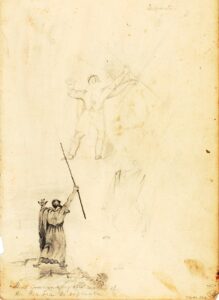
The book of Exodus, written by Moses in 1450-1410 BC, reads like an action film. Picture this: A humble shepherd named Moses, minding his own business while tending to his father-in-law’s flock when suddenly, a nearby bush burst into flames. Even weirder, the bush didn’t burn up. It just sat there burning. As Moses came closer to check out this strange phenomenon, an angel of God appeared. Moses was so overwhelmed and worried that his face might melt off that he hid his face. God then told Moses that he had a plan and he had chosen Moses to help. He said that he was going to free the people of Egypt that had been been enslaved. He was going to lead them out of Egypt and give them a new, beautiful place to live. This new place would be a land that was flowing with milk and honey.
Moses was all “Whatchoo talkin’ ‘bout Willis? You talkin’ to me?!”. I mean, he wasn’t exactly leadership material. But God was like, yes – you!
So that’s how it all began. God would transform Moses into a bold and courageous leader right before his own eyes (over the course of 40+ years or so).
But first, Moses would have to get the king of Egypt (Pharaoh) to agree to let his all these slaves go, and that was a whole ordeal in itself – involving God sending a bunch of nasty plagues – the death of Egypt’s firstborn sons being the final plague that broke the camel’s back and persuaded Pharaoh to finally let his people go.
Thus the Egyptian slaves were free. Now, a bit of background about these former slaves. This group of people were the descendants of Jacob. Jacob, you may recall was also named Israel. Thus these freed slaves were known as the Israelites.
So, Moses and the Israelites marched out of Egypt, grateful and thrilled to see what kind of beautiful future lay ahead with God’s help and guidance. Little did they know that it wasn’t going to be so easy. For one thing, Pharaoh would almost immediately change his mind about letting his people go. I mean, these Israelites were free labor and undoubtedly the Egyptian economy was suffering without them. Plus, let’s face it, all cruel leaders need people to boss around and persecute. They really don’t know what to do with themselves if they’re not oppressing someone. So Pharaoh sent his armies off after the Israelites, who were under Moses’ leadership. Pharaoh’s army was just about to trap the Israelites at the Red Sea so that they had nowhere to go and no option but to surrender and be taken back as slaves once again.
Well, the Israelites saw the Egyptian army approaching in the distance and they naturally began freaking out. They turned on Moses and were all like “Great! Now we’re gonna die here. That’s just great – thanks for nothing, Moses! We were better off as slaves!”
And now we’re up to speed, because it was at this point that Moses answered them with all the confidence and peace of a Zen master (receiving all this from the Lord God Almighty, of course). He said:
Exodus 14:14 The Lord will fight for you, you only need to be still
Can you imagine? You see hundreds of chariots full of armies thundering towards you. Your very imminent doom is, well, imminent, and someone tells you to just chillax. But Moses was only telling them what God had told him. And that was to just keep on keeping on putting one foot in front of the other and to trust that God had their back. What?! There was an actual sea in the way. How’s that gonna work?
But here’s where the coolest thing happens. God opens up the sea so that there’s a dry path for them to cross. Can you imagine? Walking on the floor of a sea with two walls of water, suspended in mid-air on either side of you? How surreal would that be? But that’s what happened and they escaped to the other side.
When Pharaoh’s army reached the sea and saw this conveniently dry path through it, they naturally thought they could simply take the same path through the sea. But God had another card up his holy sleeve. As soon as the army was in the middle of the parted sea, oops, the water slammed back together the entire army was drowned. Every last one.
Mic drop.
Now that we know the context of our verse, we understand that it was meant as an instruction from God that came in the midst of wild and unfathomably terrifying circumstances. Knowing this deepens the verse’s meaning and shows God’s strength and ingenuity even more than you may have realized at first glance.
As we dive deeper into Exodus 14:14, keep this story and contextual information at the forefront of your mind and remember that details matters when studying and learning God’s Word.